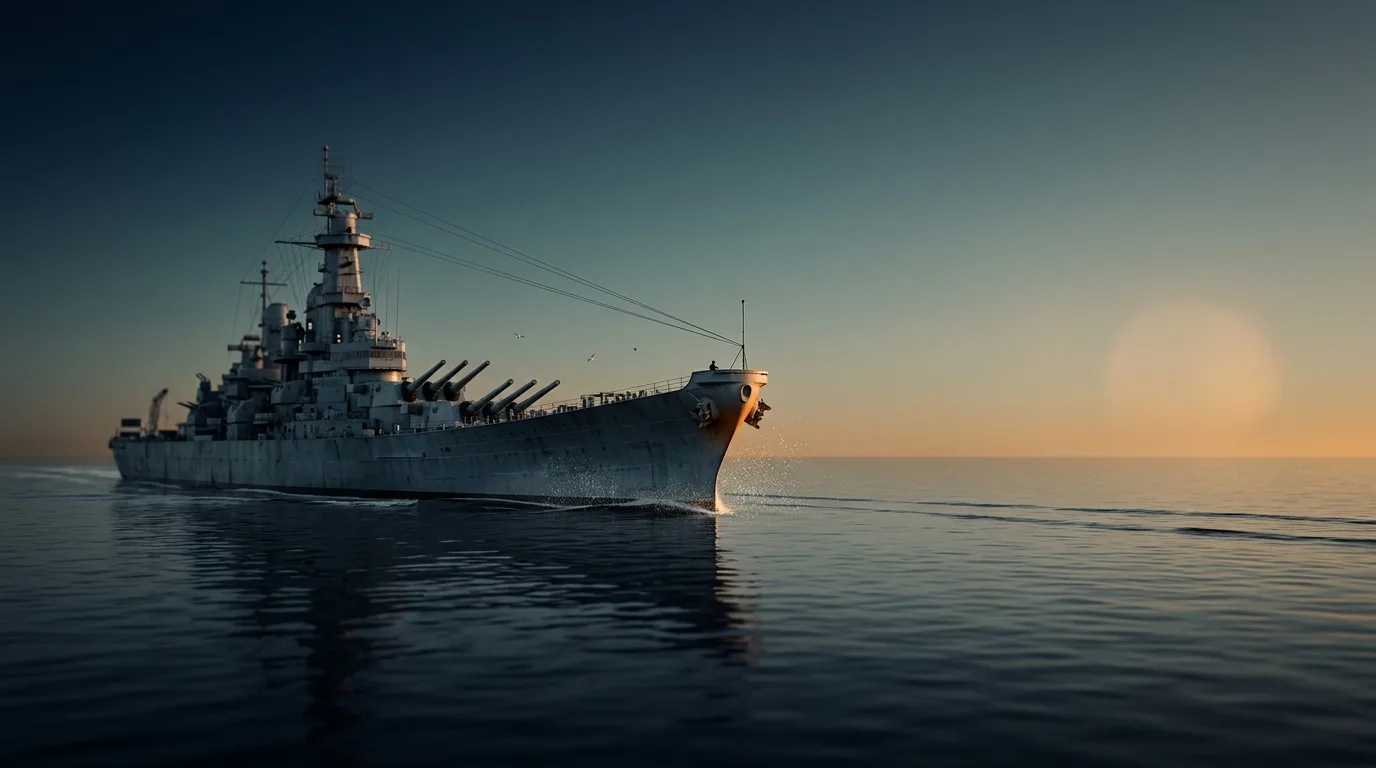
World of Warships is Wargaming's naval combat game — and the simple answer to one question: What happens when you take World of Tanks onto open water? Tanks roll across steel-tracked fields; here you command cruisers, destroyers, battleships, aircraft carriers and submarines across oceans, island chains and harbour basins. The underlying mechanics rhyme: concealed manoeuvres, broadsides, teamwork, a constant trade-off between risk and reward. But port times, ship architecture, shell types and the interplay of water, vision and range make WoWS its own game.
This guide is aimed at captains who know World of Warships only by name, as well as seasoned players who finally want to understand which statistics actually matter — and how your stats page on WG-Watch is built. We explain the ship classes, the WoWS Index, the most successful routines of experienced captains, and the social side with divisions and clans.
World of Warships: Sea battles without tanks
The core rule of WoWS is straightforward: two teams of usually twelve ships meet on a defined map. The objective is to wear down the enemy fleet, capture base flags, or control a specific area, depending on the mode. What defines the game is the mix of tactics and shipbuilding. Every ship has her own main and secondary armament, torpedoes, anti-aircraft defences, and her own appetite for shells and fuel.
Coming from World of Tanks, three differences stand out immediately:
- Range is king. WoT lives around 400-metre view ranges. In WoWS you routinely fight at 10 to 20 kilometres.
- Armour is asymmetric. Battleships soak up enormous punishment but turn slowly. Destroyers carry almost no armour and trade that for torpedoes and concealment.
- Role variety is wider. Fleets need scouts, fire support, a heavy line — and with carriers, an entirely new dimension.
That asymmetry makes the game harder for newcomers — but it is also exactly where its appeal lies. Once you understand why a destroyer stays invisible in the opening minute, why a cruiser switches to special shells at mid range, and why a battleship angles her broadside around an island rather than facing it frontally, you've crossed the entry threshold.
The five ship classes and their roles
World of Warships currently distinguishes five main classes. Each one has her own strengths, weaknesses and ideal positions on the map:
| Class | Team role | Strength | Weakness | Feel |
|---|---|---|---|---|
| Destroyer (DD) | Scout, torpedo boat, decoy | Top speed, concealment, torpedoes | Light armour, low HP, short range | Quick, risky, all-or-nothing |
| Cruiser (CA / CL) | Multi-role, fire support, anti-air | Versatility, balanced guns, flak | Less armour than battleships, less concealment than destroyers | The all-rounder between the extremes |
| Battleship (BB) | Heavy line, force through firepower | High HP, heavy guns | Large silhouette, slow speed, long reload | Frontline work, hard choices |
| Aircraft carrier (CV) | Air superiority, long-range spotting | Reach, multiple attack axes | Complex mechanics, steep learning curve | Strategic, patient, huge impact when played well |
| Submarine (SS) | Hidden strikes, late-game operations | Extreme concealment, deadly torpedoes | Fragile, limited oxygen supply | Timing game, risk versus reward |
To play World of Warships well you need at least one capable ship per class — and an understanding of which class makes sense on which map. That is also where your stats on your WG-Watch profile page come in: they show which classes you excel in and where there's still headroom.
Which statistics actually matter in WoWS
Unlike World of Tanks, where WN8 is the central number, WoWS offers no comparable official metric. Players rely on a mix of base values and community-driven indices. The most important indicators at a glance:
- Win rate — the share of battles you win. Anything above 55 percent at higher tiers is solid; sustained 60-plus percent is respectable even at Tier 10. The figure is heavily team-dependent — read it in context, not in isolation.
- Average damage — damage dealt per battle. The single most objective performance metric, because it shows what you actually contributed. Especially meaningful in relation to your ship tier.
- Average frags — enemy ships destroyed per battle. Above 1.0 is good at higher tiers; above 1.5 is very good.
- Survival rate — the share of battles you finish alive. Heavily class-dependent: a good destroyer is often sacrificed on purpose, a battleship should hold the line as long as possible.
- Accuracy — share of shells that hit. Thirty-five to fifty percent is realistic at long range, higher up close.
- Scouting contribution — how much vision your team receives through you. Destroyers and carriers drive this number, battleships almost never do.
Each of these numbers tells part of the story. The real signal emerges from how they move together — and that's exactly what the WoWS Index on WG-Watch compresses into a single score.
The WoWS Index on WG-Watch
The WoWS Index is a Wargaming-independent rating of your sea combat performance. It combines six axes — win rate, damage-per-tier, frags, survival, accuracy, and scouting contribution — into a single score between 0 and 100. 50 marks the server average, 70 means clearly above average, anything from 85 up sits at the very top of the player pool.
The number is more than a total: it breaks your performance down into the radar chart you'll find on your profile page. Six axes, your own value, and the community reference curve for comparison — so you can see at a glance whether you play evenly across the board or whether specific axes (accuracy, scouting) still have clear headroom.
Unlike the Blitz Index used for World of Tanks Blitz, the WoWS Index is calibrated per class: a destroyer is rated on spotting range and torpedo impact, a battleship on raw damage and survival. The same kind of cross-tier comparability you already know from our WoT stats guide now ships with WoWS too.
From new captain to seasoned commander: five routines
World of Warships rewards consistency more than highlight clips. Five routines help newcomers cross from the first hundred games into the steeper half of the learning curve.
1. Pick one main class and play 200 battles
Don't try to learn every class at once. Pick the one that fits your temperament — destroyer for offensive players, cruiser for all-rounders, battleship for patient tacticians — and play 200 games before you switch. By then you'll have realistic feel for positioning, aim lead, and reload timing.
2. Learn three maps thoroughly
WoWS maps repeat, and each one has its own sightlines, island positions and cover. Understanding three maps completely is worth more than half-knowing ten. Use the training room and co-op battles to scout new maps without ranking pressure.
3. Open conservatively in the first three minutes
Most losses happen in the opening three minutes — through premature attacks, poorly positioned cruisers or torpedoes launched too early. A calm opening with controlled scouting gives you and your team the information you need for the decisions that decide the mid game.
4. Switch shells deliberately
AP and HE have very different jobs in WoWS. AP does less against light targets, HE does less against armoured battleships. Players who switch shells on purpose — rather than burning through HE by default — build a clear damage lead over time.
5. Run a real division
A two- or three-ship division is meaningfully stronger than the sum of three solo players. The advantage comes from synchronisation, not mass: shared firing lines, coordinated spotting tasks, positions agreed in advance. If you don't have a fixed division yet, the WG-Watch WoWS clan directory is a sensible starting point: active clans recruit newcomers, run divisions and share tactical knowledge.
Clans, divisions and the social side
World of Warships runs on teamplay. Newcomers start in co-op or random battles. Experienced players organise themselves into divisions (short-term teams of two or three ships) and clans (long-term communities with member lists, events and an internal ranking structure).
On WG-Watch, the World of Warships clan directory mirrors that backbone: active members, shared ship activity, region and language. Within a few minutes you can find a community that matches your tempo — from relaxed weekend play to competitive clan warfare.
The Hall of Fame adds a second anchor: captains at the top of the leaderboards appear with class, region and current WoWS Index — a useful reference for setting realistic goals and measuring your own progress.
Players who solo WoWS learn the game. Players who play it together understand it.
Bottom line: improve at sea with a system
World of Warships is a game of mid range, quiet openings and big decisions. Players who play without a plan collect battles. Players who play with a plan collect skills. The five routines above — main class, three maps, conservative opening, deliberate shells, coordinated division — give a solid foundation.
The WoWS Index on your WG-Watch profile page shows you not just where you stand today, but which axes still have headroom. That self-assessment is the most important first step. The second step is finding someone to play with regularly — even if it starts as just a couple of divisions per week.
See you on the high seas, captain.